
E-commerce Inventory MIS is not about counting stock.It is about understanding where your cash is sitting, why it is not moving, and what to do next.Many E-commerce businesses look profitable on dashboards, yet struggle with cash pressure.The reason is simple: inventory absorbs cash silently.Unless you track the right signals, stock becomes money that you cannot use.
Before we go into details, here is a quick overview of the seven inventory issues every E-commerce business should monitor.
Quick Overview: Inventory Cash Leak Areas
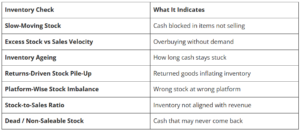
This table helps you spot risk areas at a glance.Now let’s break each one down in a practical way.
1.Identify Slow-Moving Stock Early
Not all inventory is bad.
Only slow-moving inventory creates pressure.
If a product sells once in two months, the cash invested in it stays locked far longer than expected.
What to check in your MIS:
- Units sold per SKU per month
- Days since last sale
- Contribution margin of slow sellers
Practical action:
Tag SKUs with low movement and plan price correction, bundling, or clearance before they become dead stock.
2.Compare Stock Levels with Sales Velocity
Buying inventory based on instinct is risky.
Buying based on sales velocity is disciplined.
Many businesses hold 90 days of stock while selling only 30 days’ worth.
What to check in your MIS:
- Average daily sales per SKU
- Current stock days (Stock ÷ Daily Sales)
Practical action:
Align purchase quantity with actual demand, not past assumptions.
3.Track Inventory Ageing Buckets
Inventory ageing shows how long your cash has been stuck.
Without ageing, all stock looks the same.
In reality, older stock is more dangerous than fresh stock.
Suggested ageing buckets:
- 0–30 days
- 31–60 days
- 61–90 days
- Above 90 days
Practical action:
Anything above 60–90 days should trigger a decision: push sales, revise price, or exit.
4.Watch How Returns Increase Inventory Load
Returns do not just reduce sales.
They increase inventory without bringing cash back.
Returned stock often:
- Needs repackaging
- Gets relisted late
- Stays unsold longer
What to check in your MIS:
- Return percentage by product
- Returned stock lying unsold
- Cost of reprocessing returns
Practical action:
Track return-adjusted inventory, not just purchase-based inventory.
5.Review Platform-Wise Stock Allocation
One common issue in E-commerce is stock imbalance across platforms.
You may have excess stock on one platform and stock-outs on another.
What to check in your MIS:
- Platform-wise stock availability
- Platform-wise sales velocity
- Transfer delays and costs
Practical action:
Reallocate inventory based on platform performance, not equal distribution.
6.Monitor Stock-to-Sales Ratio
A growing business should not grow inventory faster than sales.
If inventory increases faster than revenue, cash stress follows.
What to check in your MIS:
- Inventory value month-on-month
- Sales growth vs inventory growth
Practical action:
Set a rule: inventory growth should never exceed sales growth without justification.
7.Identify Dead and Non-Saleable Stock
Dead stock is cash that may never return.
These include:
- Obsolete products
- Damaged or expired items
- Unsellable returns
What to check in your MIS:
- Stock with zero sales in 6 months
- Physical vs system stock differences
Practical action:
Write off early, liquidate fast, and stop buying similar items again.
Conclusion
Inventory does not block cash suddenly.It blocks cash quietly, gradually, and repeatedly.
A strong E-commerce Inventory MIS helps you:
- See where cash is stuck
- Decide what to push or stop
- Protect liquidity without borrowing
When inventory decisions become data-driven, cash flow automatically improves.









7 Comments. Leave new
95rbet, eh? Placing some bets? Careful out there, mate! Good luck, and remember to gamble responsibly. Start here: 95rbet.
95y? Short and sweet. Wonder what this is all about. Gonna check it out. Give it a looksee yourself: 95y.
Okay, bet585app! Another betting app? I guess you can never have too many options, as long as they work! bet585app, let’s give it a shot.
E-commerce Inventory MIS is not about counting stock. It is about understanding where your cash is sitting, why it is not moving, and what to do next. Many E-commerce businesses look profitable on dashboards, yet struggle with cash pressure. The reason is simple: inventory absorbs cash silently. Unless you track the right signals ACAMS CGSS Dumps, stock becomes money that you cannot use.
Dice games are all about understanding those probabilities! It’s fascinating how platforms like jiliace ph download apk blend chance & skill – almost like applying ancient strategy to modern gaming. A fun way to test your luck!
Really interesting read! Seeing more platforms like 2jl focusing on secure, verified play (KYC is key!) is a great sign for esports betting enthusiasts. Solid analysis! 👍
Cash gets trapped when systems lack visibility. Your MIS framework mirrors what openclaw demonstrates about intelligent systems: clear signals drive better decisions. The seven-check approach transforms inventory from dead weight into actionable intelligence. Smart monitoring beats guessing.